What Lies Ahead: Foreword – by Caroline Clark
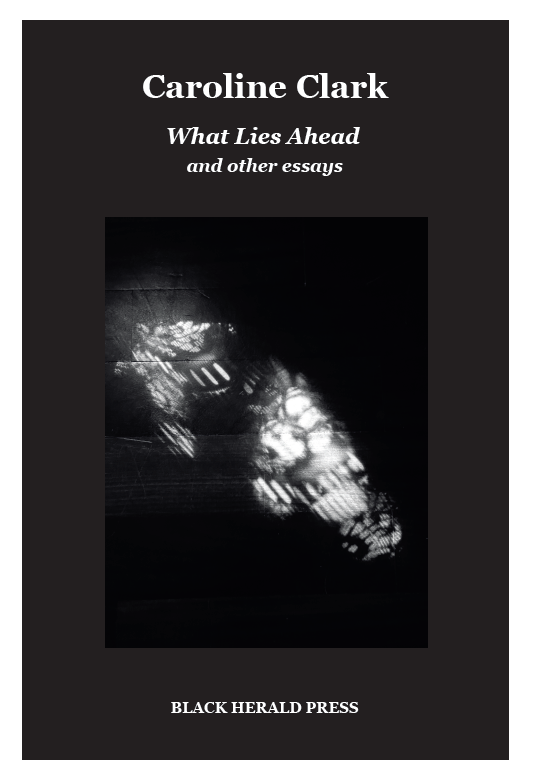
The following text was published as a foreword to What Lies Ahead, Caroline Clark’s first collection of essays (Black Herald Press, 2026).

I wrote these essays over the last eighteen years and they are laid out here, more or less, chronologically. They started appearing as a backdrop to my attempts to write poems: I needed to understand certain things so I could move forward. That forward movement is essential. Was it set up by my 2002 dissertation on Celan and Mandelstam, when I was so struck by their shared metaphor of the poem as a message in a bottle sent out to a future reader? Each essay here is a voyage or a minor sally-forth. I’m not intent on reaching a reader on the other shore, but without the promise of a reader all would become stagnant.
There is much circling back too: certain things I won’t put down, and certain repetitions are due to the fact that these pieces were written to stand alone. And there is also a movement against, as Mandelstam taught through the principle of tacking, and which I took as a lesson in how to work against anything with the power to stop me in my tracks. I like looking back seeing where I’ve been. These essays are the trail of someone who doesn’t know but wants to know. What’s the point of an essay otherwise? There is the sense of a development, a life unfolding: from Moscow to Montreal and a homecoming to Lewes. Each essay becoming more personal as I realise that certain things only make sense with reference to my own experiences. I remember at one point making the conscious decision, allowing myself, to include the personal in my essays, touching on despair, elation, having children, having cancer.
A founding principle or underlying hope to these essays could be encapsulated in a line from Celan: ‘A poem, being an instance of language, hence essentially dialogue…’ In particular, that phrase: ‘hence essentially dialogue’. It is the belief in a tripartite set-up: writer, thing written, reader. That ‘thing’ in the middle, be it poem, essay, story, object of indeterminate genre, lies between the two actors. It is a nice proposal that the two need something from one another. Are you really there? I’m here. This willingness to take part in dialogue. Is it a pretence? Am I using the image of a you to get my word out there? What if Celan, Mandelstam, Lispector and Murnane aren’t really interested in a you, just the dynamic established by such? I think that’s fine too. We are all kings of our page but know nothing puts us here if not for the possibility of a reader.
Ultimately, the movement towards, formalised for me by that message in a bottle metaphor, gives me hope. That thing between us has been delivered many times into the sea, each time different, each time destined to become something different when read. The hope that though we will not always be the same, something will remain of the source point reaching from me to you.
October 2025
Caroline Clark is the author of the poetry collection Saying Yes in Russian (Agenda Editions, 2012), Sovetica, a collection of poem-stories and photographs (2021) and Own Sweet Time: A Diagnosis and Notes, a work of experimental non-fiction (2022), both published by CB editions. She co-translated In Praise of Poetry by Olga Sedakova (Open Letter Books, 2015) with Stephanie Sandler and Ksenia Golubovich; they were awarded the 2015 Heldt Prize for Best Translation in Slavic/Eastern European/Eurasian Women’s Studies. She also edited David Rose’s novel Meridian (Unthank Books, 2015), and is a fellow of Snow lit rev. She works as a community interpreter for Russian speakers in her hometown of Lewes, UK.

